

Our services
FAQ
Marketplaces involve a lot of specific terminology. We’re happy to help you get started with this handy glossary of terms.
A
API stands for Application Programming Interface. It is a set of rules and protocols that allow different software applications to communicate with the backend systems of a marketplace. This enables them to exchange data and perform functions, such as facilitating transactions between buyers and sellers on the platform
B
A “buybox” refers to a section on an e-commerce platform, such as Amazon, where customers can directly purchase a product. On Amazon, the buybox typically appears on the right side of the product page and includes the product’s price, the option to add it to the shopping cart, and sometimes other relevant information such as the seller and shipping options. Having the buybox is important for sellers as it increases the likelihood that customers will purchase their product, especially when multiple sellers offer the same product.
C
When you, as a seller, sell products through a marketplace, you pay the marketplace owner a fee or commission to use the platform as a sales channel. Typically, this commission is a percentage of the sale price but can also be a fixed amount per transaction.
Connectors are software tools or integrations that enable communication between your marketplace platform and e-commerce sellers. Robust connectors are key to a successful marketplace, as they help manage product information, inventory, pricing, and orders. The better the integration, the more efficient the operations—leading to higher customer satisfaction.
A Content Management System (CMS) is software used to create, manage, and edit digital content. It is one of the most important tools for managing online product information and marketing content.
Cross-selling is a marketplace strategy to increase sales by recommending related or complementary products to customers who already have an item in their shopping cart. The goal is to sell more products by enhancing the customer’s purchase.
D
Data synchronization is the process of updating data between different systems so that the marketplace platform always displays current and consistent information.
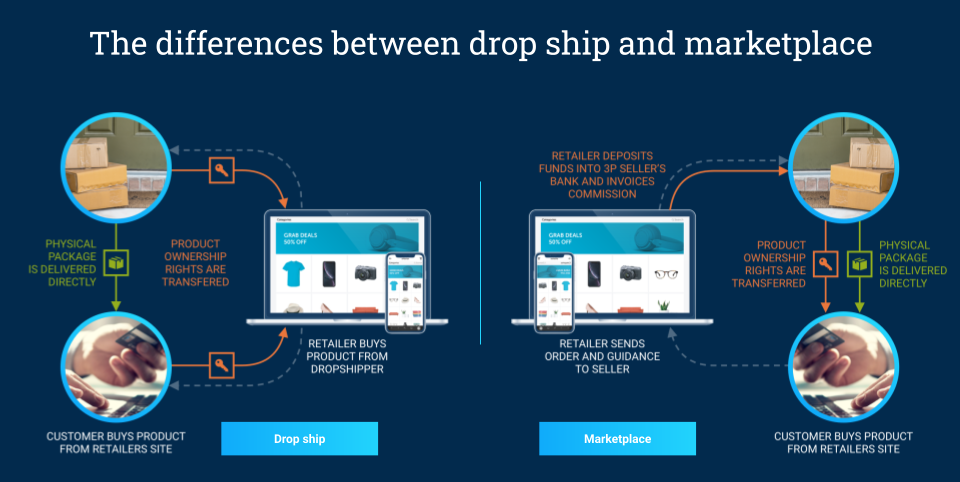
Dropshipping refers to a form of e-commerce where a retailer sells products without holding them in stock. Instead, the retailer places an order with a third party, usually a wholesaler or manufacturer, who ships the product directly to the customer.
Since inventory is not managed by the retailer, dropshipping requires lower upfront investments and allows for a wide product offering. However, selecting reliable suppliers is crucial to ensure smooth shipping and customer satisfaction.
You can sell products online through either a webshop or an online marketplace, but what are the key differences?
- Number of administrators: A webshop is an online store managed by a single business or individual, whereas a marketplace is a platform where multiple sellers offer and sell their products.
- Number of stores/brands: A webshop typically offers products from one store or brand, while a marketplace features products from various companies and brands.
- Product comparison: On a webshop, you usually see products from one seller, whereas a marketplace allows you to easily compare prices and features from different vendors, helping you make informed purchasing decisions.
- Responsibilities: With a webshop, you are responsible for all operational processes, such as website management, inventory, payment processing, shipping, and customer service. On a marketplace, you facilitate transactions, but the individual sellers are responsible for their own stock, shipping, and customer service.
F
Fulfillment is the process of handling online orders on your marketplace. It covers everything from the moment a buyer places an order to the product’s delivery. This includes order processing, packaging, shipping, and final delivery.
H
In the context of marketplaces, headless refers to an architecture where the frontend (user interface) is separated from the backend (logic, databases, and infrastructure).
A headless marketplace allows the frontend to be developed independently, giving more flexibility to create customized experiences across web, mobile, or other platforms. This setup allows marketplaces to innovate faster without disrupting backend systems.
I
Integration is the process of connecting and synchronizing various systems, applications, and services to ensure seamless operation of marketplaces. This provides a smooth experience for both sellers and buyers.
K
KYC stands for Know Your Customer. It’s a process where sellers verify the identity of their users to prevent fraud and ensure secure transactions.
M
A marketplace is an online platform where multiple sellers offer their products or services to consumers. Think of it as a virtual marketplace where buyers and sellers meet to conduct online transactions.
Marketplaces are hugely popular due to their ease of use, customers can access a wide range of products at competitive prices, all from the comfort of their homes.
As marketplace popularity grows and consumer behavior evolves, having a strong marketplace strategy is key. It’s essential to stand out from competitors, offer excellent customer service, use data effectively for decision-making, and manage costs and risks wisely.
Let Operai help you implement the right strategy. By setting up your marketplace properly from the beginning and considering all critical success factors, you’ll set yourself up for a successful launch.
Middleware is software that acts as a bridge between different applications or systems, enabling them to communicate and exchange data smoothly.
Modularity in software refers to designing a system with separate, independent components (modules) that each handle specific tasks, such as product management, pricing, or order processing.
This design allows marketplaces to easily adapt to changing needs, integrate with external tools, and scale effectively.
A Minimum Viable Product (MVP) is the first version of a platform that includes just enough features to deliver value to early users. It allows you to launch quickly, gather feedback, and improve the product based on real user insights—without heavy investment in full development from the start.
P
PSP stands for Payment Service Provider. A PSP is a company that enables electronic payments by facilitating the processing of financial transactions between buyers and sellers.
One of the key features of PSPs specifically designed for marketplaces is their ability not only to receive payments, but also to distribute them among multiple sellers. This process is commonly referred to as split payments or payment splitting.
How does it work?
- Central payment collection: When a customer makes a purchase on a marketplace, they pay the full amount to the marketplace. The PSP receives this payment.
- Payment distribution: Upon receiving the funds, the PSP automatically distributes the amount among the various sellers involved in the transaction. This can happen in real-time or based on a predefined schedule.
- Transaction fees: The PSP can also automatically deduct transaction fees before transferring the funds to the sellers. This means sellers receive a net amount that already accounts for any applicable fees.
- Flexible payment structure: The PSP supports various payout structures depending on the agreement between the marketplace and its sellers. This could be a percentage of the sale price or a fixed fee per transaction.
Thanks to PSP functionality, marketplaces can optimize their business model and offer a smoother experience for both buyers and sellers.
PaaS stands for Platform-as-a-Service. It is a cloud computing model that provides an ideal platform for developers to build, test, deploy, and manage a marketplace without having to worry about the underlying infrastructure.
PaaS platforms operate using APIs and offer integration capabilities with other services such as payment processors, shipping providers, and CRM systems; making it easy to create a seamless user experience.
Since PaaS providers manage infrastructure – including updates, security, and backups—marketplace owners can focus on developing their products and services without having to deal with technical details.
The platform economy is a flexible economic model where digital platforms facilitate economic activity. Buyers and sellers connect on the platform to exchange goods, services, or information.
Such platforms generate large amounts of data on user behavior and transactions. This data allows you to optimize services, offer personalized customer experiences, and develop new service
Product Information Management (PIM) is a system used to centralize and manage product data and information. It ensures that product content is always up-to-date and consistent across all channels. This increases the quality of your product data and has a positive impact on product sales within your marketplace.
R
The return policy refers to the set of rules and conditions established by the marketplace that define how and under what circumstances buyers can return their products after purchase. It usually includes the following elements: a return period, the reason for the return, the condition of the product, refund options, shipping costs, and exchange possibilities.
S
A SaaS solution stands for Software-as-a-Service. In this software delivery model, the software is hosted and maintained by a service provider and made available online. Customers do not need to install or maintain the software on their own computers but can access and use it through a web browser.
Scalability is a crucial success factor for marketplaces: it ensures that your platform can grow in the future without affecting its performance. Growth refers to an increasing number of sellers, users, and transactions. In short: by choosing scalable technology, you make your marketplace future-proof.
This is the process of bringing new sellers onto your marketplace. It involves registering them, setting up their accounts, and providing hands-on guidance on how to sell products or services through your platform.
At Operai, we ensure you can easily onboard new sellers through training and workshops. Once your marketplace is ready, you’ll have the right seller onboarding skills to confidently welcome and support new vendors. This sets your marketplace up for the best possible start.
SEO for marketplaces refers to optimization strategies used to improve the visibility of product listings within a marketplace. It works similarly to search engine optimization (SEO) for websites. By applying these strategies, you can increase the visibility of your products or services on marketplaces, leading to more traffic, higher conversions, and increased revenue.
U
This is a marketplace strategy aimed at increasing product sales by offering a more expensive or advanced version of a product the customer is considering. The key is to convince the customer of the added value and benefits of the upgrade.
User Experience (UX) refers to the overall digital experience of customers and users on your marketplace. The focus lies on usability and customer satisfaction.
W
A webhook allows an application to send real-time data to another application when a specific event occurs—for example, when a new order is placed on your marketplace.
“66% of consumers prefer shopping on an online marketplace”